
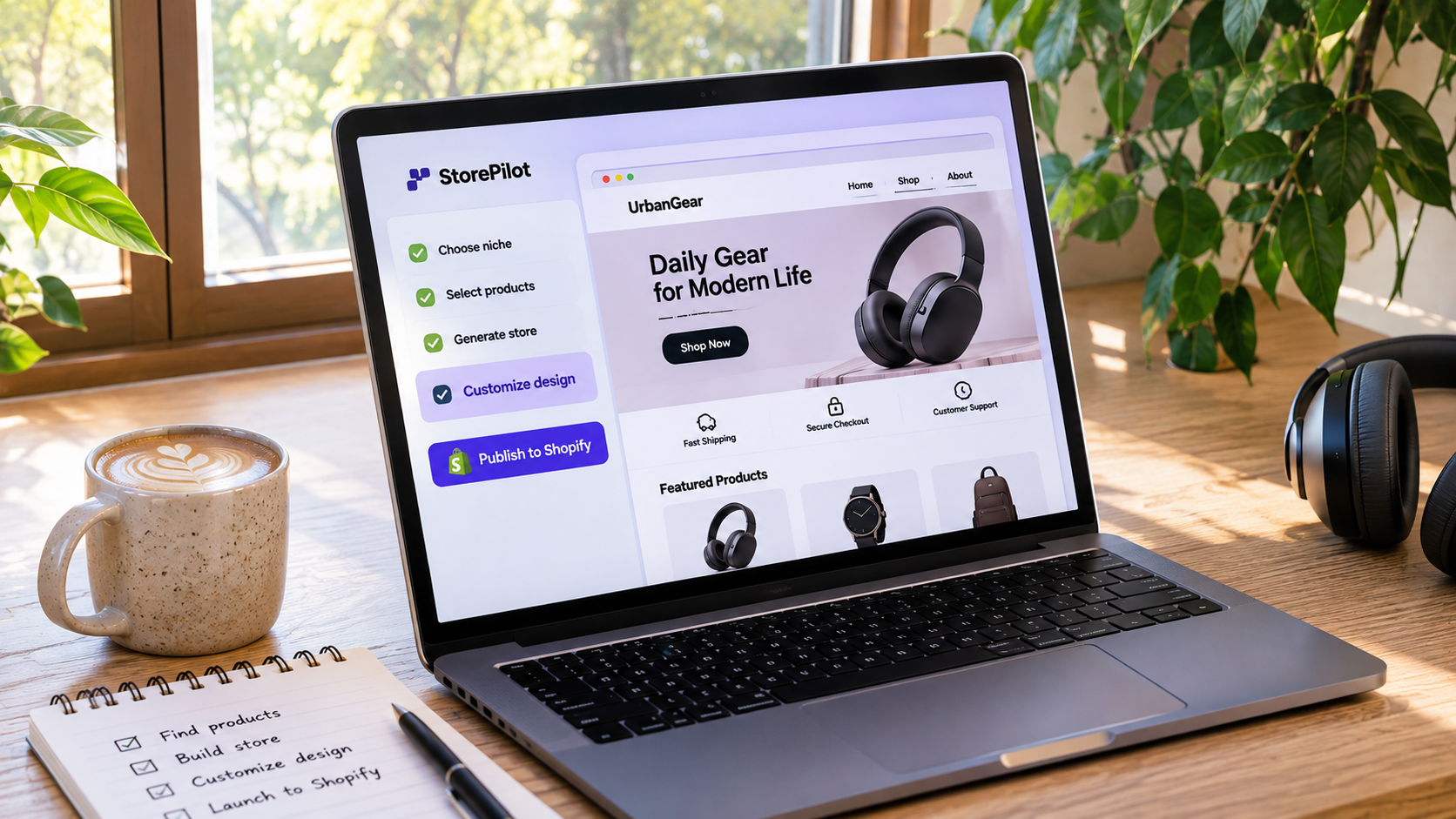
Launching a dropshipping store no longer means spending days choosing a theme, building product pages, and writing every description from scratch.
AI store builders can handle much of that initial work. Some generate a complete Shopify storefront from a product link, while others help merchants create product pages, customize layouts, and prepare landing pages for advertising campaigns.
For dropshippers, that can make a real difference. The faster you can prepare a store and launch new products, the more time you have to evaluate suppliers, refine your offers, and understand what customers actually want.
But there’s an important distinction between generating an entire store and creating individual pages.
If you’re launching your first Shopify business, you’ll probably want a tool that helps build the storefront itself. If you’re already selling products, you may get more value from a builder that speeds up product launches and campaign creation.
Here are ten AI-assisted Shopify builders worth considering in 2027, including what they do well, how much they cost, and which dropshipping workflows they suit best.
Best AI Shopify Store Builders Compared
|
Tool |
Best For |
Builds a Full Store? |
Starting PaiPricingd Price |
| PagePilot / StorePilot | Store launches and product testing | Yes, through StorePilot | PagePilot $39/mo |
| Atlas AI | Complete AI-generated storefronts | Yes | $39/mo |
| DropMagic | Dropshipping stores and product positioning | Yes | $79/mo |
| GemPages | Product pages and sales funnels | No | $29/mo |
| PageFly | Page creation and optimization | No | $24/mo |
| Instant | AI-assisted custom layouts | No | $39/mo |
| EComposer | Customizing multiple Shopify page types | No | $25/mo |
| Omnise (formerly Beae) | AI page generation and visual editing | No | $19.99/mo |
| Replo | Advertising landing pages | Primarily landing pages; also supports AI storefront creation | $119/mo |
| Shogun | Branded storefront customization | No | $39/mo |
The biggest difference isn’t necessarily the monthly price. It’s how much work each tool takes off your plate.
A full-store builder can help you get a new business online, while a product page builder becomes more useful when you’re testing new offers regularly.
1. PagePilot — Best for Launching and Testing Dropshipping Products
Finding a product worth selling is only the beginning.
You still need to prepare the product page, write descriptions, organize images, and create a layout that gives shoppers enough information to make a purchase.
Doing that once isn’t particularly difficult. Doing it for five or ten new products every month gets repetitive.
PagePilot is designed to simplify that process.
You start with a supported product URL, and the platform generates an editable Shopify product page with AI-assisted copy, imagery, and product sections.
From there, you can adjust the text, replace images, rearrange sections, and publish the page directly to Shopify.
PagePilot includes more than 35 customizable conversion-focused sections and blocks, product research capabilities, and AI tools for creating static advertising creatives.
That combination is particularly useful for dropshippers testing new offers. Instead of treating product research, page creation, and advertising visuals as completely separate tasks, merchants can handle more of the preparation within one workflow.
What About Building the Store Itself?
PagePilot focuses on generating and customizing product pages, but the same team also offers StorePilot.
StorePilot is a separate AI store builder that generates an initial Shopify storefront, including a theme, homepage, and product selection.
For someone starting from scratch, StorePilot helps establish the store. PagePilot then supports the next stage: creating product pages and preparing new products for launch.
That makes the two tools relevant at different points in the same dropshipping workflow.
The AI Shopify store builder approach is particularly useful for merchants who want to spend less time assembling storefront content and more time testing products and improving their offers.
Pricing: PagePilot Lite starts at $39/month with 10 product or homepage generations and 50 AI images. Starter costs $59/month and includes unlimited page generation, 200 AI images, and support for three Shopify stores. StorePilot offers free initial store generation.
Best for: Dropshippers launching a Shopify store, regularly testing products, and creating product pages without starting from scratch each time.
Worth knowing: The Lite plan includes 10 page generations per month. Merchants testing several products each week may find Starter more practical, especially when managing multiple stores. StorePilot and PagePilot are separate products, so merchants should also account for any Shopify subscription and ongoing PagePilot costs.
2. Atlas AI — Best for Creating a Complete Store Quickly
Atlas is built for merchants who want to move from a product idea to an initial Shopify storefront with less manual setup.
Instead of choosing a theme and creating every page individually, you provide a product URL and let the platform generate a store structure with product pages, layouts, and AI-written content.
This is useful when you’ve found a product you want to test but haven’t created a Shopify store yet.
Atlas handles much of the initial design and content work, leaving you to review the generated storefront, adjust the product information, and configure the operational details.
It also includes cart upsells and product bundling features.
Those can be useful for stores selling related products, such as accessories that complement a main item.
The main advantage is the starting point: you get an initial storefront rather than an empty theme that still needs to be assembled.
Pricing: Starts at $39/month, with additional usage options for pages, bundles, and cart features.
Best for: Dropshippers who have identified a product and want to create a complete Shopify storefront around it.
Worth knowing: Additional pages, bundles, and cart features may affect the total subscription cost. Check what’s included in the base plan before committing.
3. DropMagic — Best for Dropshipping Store Design and Product Positioning
Two stores can sell similar products and still appeal to completely different customers.
One might emphasize affordability, while another focuses on convenience, premium quality, or a specific problem the product solves.
DropMagic is interesting because it combines AI storefront generation with tools for developing those different marketing angles.
Its Strategy feature helps merchants work with customer personas and product positioning.
For example, a merchant selling a portable blender might want one version of the messaging aimed at gym-goers and another aimed at busy professionals.
DropMagic helps merchants develop those approaches while building the storefront.
The platform also provides customizable ecommerce sections, including banners, reviews, and sticky add-to-cart elements.
This makes it relevant to dropshippers who want more than a generic product page and prefer to shape their store around a particular audience.
Pricing: The Pro plan costs $79/month. A free generation option is available, but publishing to Shopify requires a paid plan.
Best for: Merchants creating a dropshipping store who want AI-assisted design and more control over product positioning.
Worth knowing: Free generation is useful for exploring the platform, but you’ll need a paid subscription to publish the generated store to Shopify.
4. GemPages — Best for Custom Product Pages and Sales Funnels
GemPages is a better fit when you already have a Shopify store and want more control over individual pages.
Its visual editor supports product pages, promotional landing pages, and sales funnels.
One of its more useful features is GemAI Image-to-Layout, which can turn a visual reference into an editable layout.
Say you’re preparing a campaign for a new product and have found a landing page structure you like.
Instead of rebuilding every section manually, you can use that reference as a starting point and customize the result.
GemPages also supports funnel workflows and post-purchase offers, which can be useful when you’re promoting bundles or related products.
The trade-off is that you’re still making many of the design decisions yourself.
Pricing: Paid plans start at $29/month. A limited free plan allows one published page.
Best for: Dropshippers creating custom product pages, promotional layouts, and sales funnels.
Worth knowing: GemPages focuses on page customization rather than generating a complete Shopify storefront from a supplier product link.
5. PageFly — Best for Improving Existing Product Pages
Once a dropshipping store starts receiving traffic, the challenge changes.
You’re no longer just trying to publish a page. You’re trying to understand whether that page is doing its job.
Maybe the product benefits aren’t clear enough. Perhaps customers aren’t reaching the reviews section. Or the layout needs to work better on mobile.
PageFly combines visual page building with AI-assisted creation and optimization features.
Merchants can build product pages, landing pages, and other Shopify layouts, then continue adjusting them after publication.
Higher-tier capabilities include analytics, heatmaps, and A/B testing on eligible plans.
That makes PageFly particularly relevant to stores that already have visitors and want to improve how their pages perform.
One detail worth checking is the publishing model. PageFly uses published page and section slots, so the number of layouts you maintain affects which plan you’ll need.
Pricing: Paid plans start at $24/month for five published page or section slots. A limited free plan includes one published slot.
Best for: Existing dropshipping stores that want to create, customize, and improve product or landing pages.
Worth knowing: Publishing limits and advanced optimization features vary by subscription. Stores running several campaigns should calculate how many live slots they’ll need.
6. Instant — Best for AI-Assisted Custom Shopify Layouts
Instant makes more sense when you already have a visual direction for your store.
Its AI Agent can work with prompts, screenshots, website URLs, and Figma references to help create editable Shopify layouts.
That gives merchants several ways to communicate what they want without describing every design detail manually.
For example, a store owner might have a landing page concept prepared by a designer or a screenshot showing a particular section arrangement.
Instant can use that reference to guide the layout creation process.
It also supports reusable sections and product or collection templates, which can help maintain consistency across different parts of a store.
Compared with a product URL generator, Instant places more emphasis on how the finished page should look.
Pricing: Starter costs $39/month. A free Developer plan is available for development stores.
Best for: Merchants who want customized Shopify layouts based on prompts or existing design references.
Worth knowing: Instant works best when you have some direction for the design. Merchants looking for a straightforward product URL-to-page workflow may find it more involved.
7. EComposer — Best for Stores With Multiple Product Categories
A single-product dropshipping store doesn’t need many different layouts.
A store selling home accessories, travel products, and electronics probably does.
EComposer supports that broader editing work through a visual builder for homepages, product pages, collection pages, and landing pages.
Its templates and reusable elements help merchants create different layouts while keeping the overall store design consistent.
For example, a merchant could build a seasonal collection page, a dedicated promotion, and more detailed product pages for items that need extra explanation.
EComposer also includes ecommerce extensions for additional storefront functionality.
Pricing: Paid plans start at $25/month. A limited free plan is available.
Best for: Dropshipping stores managing multiple product categories, collections, and promotional pages.
Worth knowing: Published page limits and AI credits vary by plan. Stores planning a larger redesign should estimate how many live pages and sections they’ll need.
8. Omnise (Formerly Beae) — Best for AI-Assisted Shopify Page Design
Omnise, previously known as Beae, combines prompt-based generation with a visual page editor.
Merchants can describe the page they want to create, generate an initial structure, and then customize the result.
Its AI Blueprint feature helps structure page creation, while section-level A/B testing supports comparisons between design variations.
For a dropshipper preparing a product campaign, this can be useful when the goal is to create a landing page quickly but still have control over the final layout.
The workflow sits somewhere between automated generation and hands-on visual editing.
Pricing: Paid plans start at $19.99/month for three published slots. A free plan includes one watermarked published slot.
Best for: Merchants who want AI-generated page layouts with visual editing and testing features.
Worth knowing: The number of published slots depends on the plan. Stores maintaining several campaign pages may need a higher subscription tier.
9. Replo — Best for Advertising Landing Pages
Replo is particularly relevant to ecommerce businesses that create dedicated landing pages for advertising campaigns.
A standard product page may be suitable for visitors browsing a store, but a paid campaign often needs a more focused presentation.
For example, a merchant might want a page built around a particular offer, customer problem, or product bundle.
Replo supports AI-assisted landing page and storefront creation using prompts, URLs, Figma designs, and advertising references.
It also connects with Shopify catalogs and checkout, allowing merchants to build campaign-specific experiences.
Although Replo offers broader AI creation capabilities, its landing page workflow is a major reason to consider it.
Pricing: Paid plans start at $119/month, with additional options for more extensive usage.
Best for: Dropshipping businesses running paid advertising campaigns that require customized landing pages.
Worth knowing: Replo has a higher starting price than most tools in this comparison. It’s more practical for businesses creating campaign pages regularly than for occasional storefront edits.

10. Shogun — Best for Consistent Branded Storefronts
Some dropshipping businesses eventually move away from testing unrelated products and start building a recognizable brand.
At that point, consistent design becomes more important.
Shogun provides a visual editor and reusable content sections that help merchants maintain similar layouts across multiple pages.
A store might want to reuse product education sections, brand messaging, or promotional content without rebuilding those elements each time.
Shogun also offers page analytics and additional content management features on higher plans.
It’s particularly relevant to merchants who already have an established storefront and want to keep the presentation consistent as their catalog grows.
Pricing: Paid plans start at $39/month. Free Draft Mode allows merchants to create and preview pages without publishing.
Best for: Dropshipping businesses developing a consistent brand identity across their Shopify store.
Worth knowing: Shogun focuses on storefront customization rather than automated product research or supplier management.
Full Store Builder or Page Builder: Which Should You Choose?
The first decision isn’t which subscription to buy. It’s whether you need to build a store or improve the one you already have.
A full-store builder helps generate the initial storefront, including its structure, design, and starting content.
A page builder focuses on creating or customizing individual pages within an existing Shopify store.
Both can be useful, but at different stages of a dropshipping business.
|
Your Situation |
What to Prioritize |
| You haven’t launched a Shopify store | Full-store generation |
| You’re testing new products every week | Product URL-to-page generation |
| You’re running paid advertising campaigns | Landing page flexibility and publishing limits |
| You’re improving an existing store | Visual editing and optimization features |
| You’re building a recognizable brand | Reusable layouts and consistent design |
For someone starting from scratch, a dedicated AI store builder can remove much of the work involved in creating the first version of a storefront.
For someone testing five new products a week, generating another entire store may not be necessary. A faster product page workflow could be more valuable.
This is where combining store generation with ongoing product page creation becomes useful.
StorePilot can help merchants generate the initial Shopify storefront, while PagePilot supports the next stage of preparing product pages and new offers.
Rather than treating store creation as a one-time project, this gives merchants a workflow they can continue using as they test products and develop their business.
What AI Store Builders Cannot Solve for Dropshippers
An AI builder can make a dropshipping store look professional quickly.
What it can’t do is make an unreliable supplier dependable or turn an unprofitable product into a successful business.
A polished landing page won’t help much if customers receive the wrong item, shipping takes longer than promised, or the product doesn’t match its description.
Before launching a product, merchants still need to review several things.
|
Area |
What to Check |
| Supplier reliability | Product quality, stock availability, and fulfillment history |
| Shipping | Realistic delivery times, tracking, and shipping costs |
| Product information | Accurate specifications, materials, images, and compatibility |
| Returns | Refund policies and how returns are handled |
| Profitability | Product cost, shipping, advertising, transaction fees, and refunds |
| Compliance | Shopify requirements and applicable consumer protection rules |
Product research features can help identify opportunities, but the final decision still requires judgment.
The same applies to AI-generated descriptions and images.
Before publishing, compare the generated content with the actual product. A convincing description is only useful if the claims are accurate.
For dropshippers, the goal should be to use AI to reduce repetitive work without losing control over the details that affect customer satisfaction.
How to Choose an AI Shopify Builder Without Overpaying
The cheapest subscription isn’t necessarily the one that offers the best value.
A low-cost page builder may work well for occasional edits, but it could become restrictive if you regularly launch new products or maintain several campaign pages.
Likewise, paying for advanced design features doesn’t make sense if your main task is generating product pages from supplier listings.
Before subscribing, consider the following questions.
How many products will you launch each month?
If you’re testing products frequently, look for a builder that simplifies page generation and doesn’t force you to recreate the same layouts manually.
Do you need a complete storefront or individual pages?
If you’re starting from scratch, a dedicated AI store builder can save time on the initial setup. If you already have a Shopify store, focus on the part of your page creation workflow that needs improvement.
Will you run paid advertising?
If so, consider how easily you can prepare landing pages, update offers, and create supporting visuals.
Who will maintain the store?
A solo merchant may benefit from a straightforward generation workflow, while a larger team might want more control over reusable templates and design references.
What happens when you need more capacity?
Check the next pricing tier before signing up. Some builders limit AI generations, published pages, or advanced features.
The right builder should help you get a store ready faster and make future product launches easier. Saving a few dollars each month matters less if the workflow creates hours of unnecessary manual work.
Frequently Asked Questions
Can AI build an entire Shopify dropshipping store?
Yes. Tools such as StorePilot, Atlas, and DropMagic can generate initial Shopify storefronts. Merchants still need to review the design, configure payments and shipping, and establish reliable fulfillment arrangements.
What’s the difference between an AI store builder and an AI page builder?
An AI store builder focuses on generating an initial storefront, while an AI page builder creates or customizes individual pages within a store. Some platforms support both workflows.
Do AI Shopify builders help with product research?
Some do. Product research features can help identify products worth investigating, but they don’t guarantee demand, profitability, or reliable suppliers.
Are free AI Shopify store builders suitable for dropshipping?
Free store generation can be a useful starting point, particularly for merchants exploring their first Shopify business. However, merchants should check what is included, whether publishing requires payment, and what ongoing subscriptions they’ll need.
Final Thoughts
For dropshippers starting a new Shopify business, an AI store builder can remove much of the repetitive work involved in getting a storefront ready.
StorePilot is worth considering for generating the initial store, while PagePilot helps merchants turn product listings into editable Shopify pages, prepare AI-generated visuals, and launch new offers without rebuilding everything manually.
Together, they offer a practical workflow for merchants who want to launch a store, test products, and keep improving their product pages as the business grows.
Other tools in this comparison serve different needs. Atlas and DropMagic focus on AI-assisted store generation, while GemPages, PageFly, Instant, EComposer, Omnise, Replo, and Shogun offer different approaches to customization and campaign creation.
The right builder should do more than make your store look good. It should make launching and testing products easier, while leaving you time to focus on suppliers, offers, and customer experience.
About the Author
Mika Kankaras is a B2B SaaS writer with over 6 years of experience covering marketing automation, AI workflows, customer experience software, and business technology. She specializes in researching and comparing software, translating complex product features into clear, practical insights for business users.